
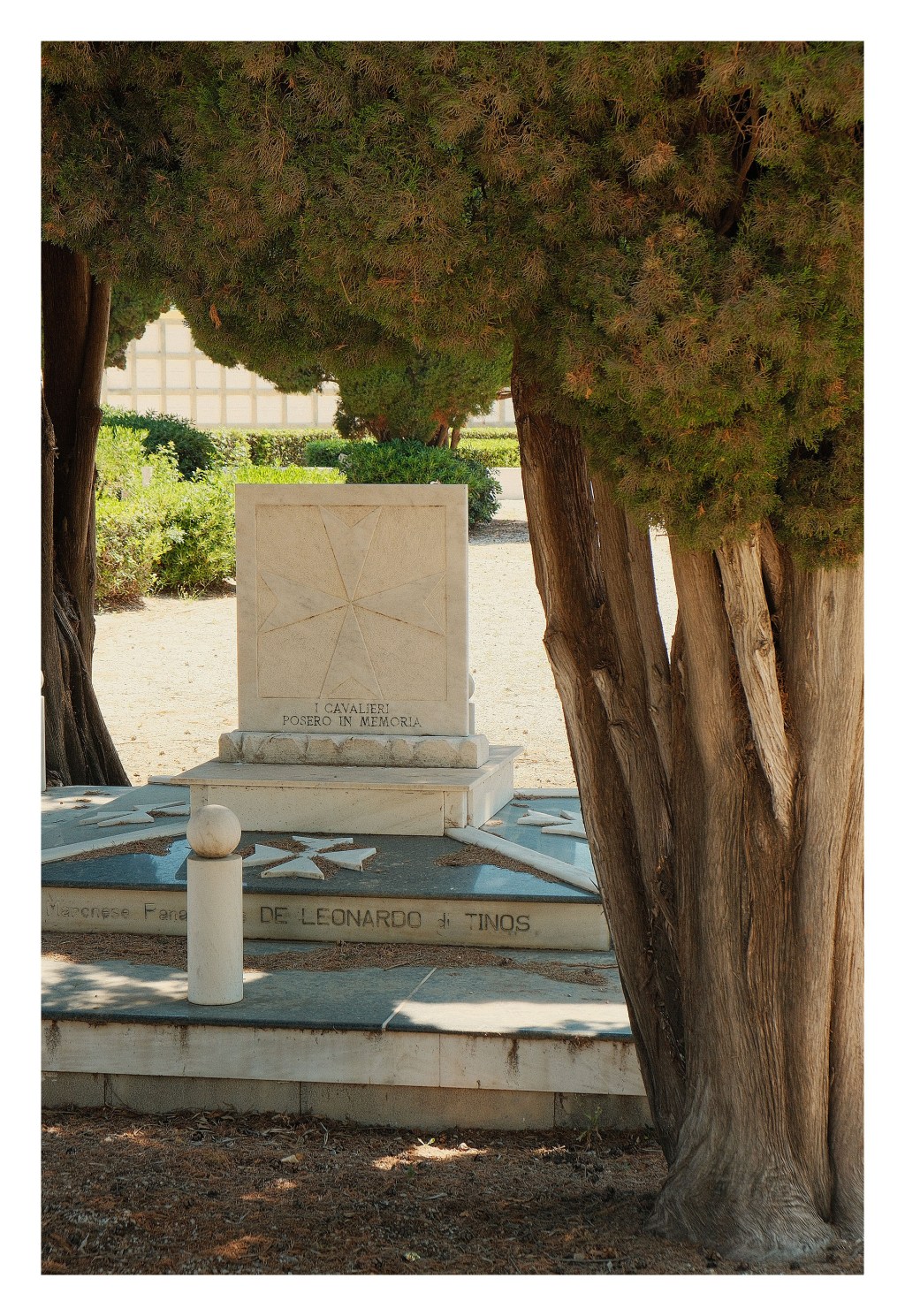
(Pictured: Rhodes Cemetery, Greece. A rose cross monument dedicated to the Knights of Rhodes – I think)
It’s unfair that people compare Foucault’s Pendulum to Ulysses.
Ulysses is a novel that spans an entire day but some take years to finish. On the other hand, Eco’s Pendulum is a novel that covers a few years but can be read in a few days. Sure, they are both abundant in references, but the story in Ulysses is obscured precisely by all these references. Pendulum‘s references, on the other hand, might get overwhelming but this is part of its charm.
I won’t give spoilers, especially for the ending, I’ll just mention what’s probably on the book jacket: the story follows three editors who make up a conspiracy theory concerning the Knights Templar. Being a philosopher and medievalist, Eco of course has fun with this story and inserts an uncountable number of references to historical characters, events, books and so on. You can follow along and join the madness, sure, or just nod and carry on, like you do when that relative starts spouting InfoWars talking points at Christmas dinner…
Apophenia is people’s tendency to find patterns and connections within seemingly unrelated things. Wouldn’t you know it, I had such a fun time with this book because I became one of the characters for a week. I had no idea what it was about when I picked it as my June beach read in Rhodes. And wouldn’t you know it, a few of the book’s major plot points happen right in the middle of June. And while Rhodes wasn’t the Templar’s headquarters, it was, for a few centuries, the HQ of the Knights Hospitaller (Knights of St. John, or the Knights of Malta today). So of course I had so many connections around me – the symbol of the Rose Cross, the sculptures of Knights, the flags. It was exactly like if I randomly picked up Ulysses and read it on a trip to Dublin. Which I haven’t done.
What is most hilarious is that the Knights Templar conspiracies aren’t exactly recent. They started around the 1700s. Freemasonry started as medieval guilds, but they wanted to have a fancier history so they made up a connection to the Templars. In the 1950’s another chapter starts, with Pierre Plantard who… planted fake documents in the French Archives, and started the whole “Priory of Sion” conspiracy. In 1982 comes the final blow, where three Brits read the Priory stuff and make up their own crap about “The Holy Blood and the Holy Grail”, where they make up a conspiracy that the Templars were hiding the bloodline of Christ. Does this sound familiar?
Eco probably read all this stuff and found it absolutely hilarious, so he made his own version about these nutjobs… And yet 15 years later comes Dan Brown and his audacity DaVinci Code. Without any sense of shame, he decides to embody the satirised characters in Eco’s Pendulum, publishing his own conspiracy, making it a bestseller, stirring the pot for decades to come. It’s a damn shame because the Templars’ actual history is fascinating in and of itself, they didn’t need bells and whistles added…
It is also, in a way, irresponsible, because one of the lessons of Foucault’s Pendulum is that fiction has power and can affect the real world. Yes, the consequences in Eco’s book are fictional, but we’ve seen far too often how made-up conspiracies become real for some. Just wait for Christmas and ask that InfoWars relative.








 Seb's Web
Leave a comment